Nut butters (including peanut butter – peanuts are technically a legume) are “ground” nuts/kernels made into a paste. In practice, they are an energy‑dense food with a high content of unsaturated fatty acids, a significant amount of protein and fibre and micronutrients typical for the given nut (e.g., vitamin E, magnesium). For health and weight management, the key is the composition and portion size – not marketing labels.
What nut butters contain
1) Fats (mainly unsaturated)
Most of the energy comes from fats – primarily monounsaturated (MUFA) and polyunsaturated (PUFA) fatty acids. That’s why nuts and their products typically appear in recommendations for a “cardioprotective” diet.
2) Protein and fibre
Nut butters are not a “protein food” in the sense of lean meat or dairy, but they usually provide several grams of protein per serving. Fibre content varies by type.
3) Micronutrients and bioactive compounds
They typically contain vitamin E (especially almond and hazelnut), magnesium, phosphorus, zinc, manganese, various polyphenols and other antioxidants (nut‑specific).
4) Energy: why portion size is key
A serving of 1–2 tablespoons (approx. 15–30+g) usually provides ~100–200 kcal, depending on the type and size of the spoon. This is an advantage (easy energy boost), but also a risk (easy calorie surplus when trying to lose weight).
5) Emulsifiers and “E‑numbers”
Emulsifiers (and “E‑numbers” in general) are often added to nut butters for texture and stability (to reduce oil separation). The E‑number itself does not mean the substance is dangerous – in the EU, it designates an additive that has passed safety assessment and is approved for use under specified conditions.
Interested in E‑numbers? Read the article: E‑numbers in food: how to understand them?
What nut butter should and shouldn’t contain
What it should contain
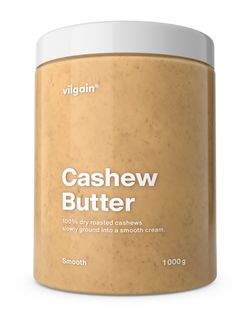
- 100% nuts/kernels (e.g., “roasted peanuts” / “almonds” / “cashews”).
- Optional: nut pieces (in “crunchy” variants).
- At most: trace amounts of naturally occurring salt/carbohydrates – but this is already part of the raw material, not an addition.
A useful rule is: the shorter the ingredient list, the better. Single‑ingredient products like 100% nut butters also typically show a common phenomenon – separated oil on top (see FAQs).
What can be included and still be fine
- Cocoa/dark chocolate: fine for taste, just make sure it’s not unnecessarily sweetened.
- Protein (WPC/WPI, dairy, pea, etc.): can help with protein intake, but check how much is actually in a serving.
- Spices and flavours (cinnamon, vanilla, cardamom, chilli): usually not a problem.
- Nut pieces/seeds: nutritionally fine, but may increase “palatability”, so watch your portion if trying to lose weight.
What is better to limit or avoid
- Added sugar: Added sugar increases palatability and makes overeating easier, and unnecessarily turns the product into a “sweet spread”. From a population health perspective, it’s worth keeping added sugars low overall (WHO: <10% of energy, ideally <5%). The AHA (American Heart Association) gives practical limits for added sugars (approx. 25g/day for women, 36g/day for men).
- Salt: Salt itself is not “forbidden”, but with nut butters, the problem is that it adds up from all foods throughout the day. The AHA recommends ≤2300mg sodium/day, ideally around 1500mg/day for most adults. So, if you already eat a lot of salty foods, it makes sense to choose nut butter without added salt.
- Palm oil (and added fats in general): Palm oil is mainly added for texture, price and stability. Nutritionally, this often increases the proportion of saturated fatty acids, which at higher intakes raise LDL cholesterol (“bad”). If you want butter “as close to nuts as possible”, added fats don’t make much sense.
- Xylitol: Xylitol is generally considered safe for humans, but at higher doses (typically tens of grams) it can cause bloating and diarrhoea – like other polyols.
How to include nut butter (and when not to)
When it works well
1) For satiety and to round out a meal. If your meal is low in fat (e.g., quark + fruit / oatmeal / bread with ham), a tablespoon of nut butter can improve satiety and taste.
2) To increase calorie intake. For athletes, people with higher energy expenditure or during bulking, it’s one of the easiest ways to increase energy without a large food volume.
3) In combination with fibre and protein. Typical combinations:
- yogurt/quark + fruit + a spoonful of butter
- porridge
- whole grain bread + butter + protein source (e.g., skyr/quark/egg)
When to be more careful
- Nut butter can be easy to overeat (“I had half the jar”). Helpful strategies:
- use a measured portion (spoon/scales)
- choose “less addictive” forms (e.g., whole nuts)
- include it in meals, not as random snacking
- Right before intense training, if higher fat intake makes your stomach feel heavy (individual).
- If you have a nut/peanut allergy, obviously it’s a no‑go.
FAQs
1) Is nut butter suitable for weight loss?
Yes – it can be, if it fits into your overall calorie intake and helps you stick to your plan.
Meta‑analyses show that including nuts in the diet typically does not increase body weight in clinical studies, and in observational data, higher nut consumption is associated with less long‑term weight gain.
However, there is a difference between eating whole nuts and nut butter.
When losing weight, it’s good to watch your portions. Start with one tablespoon (measured not by eye), ideally add it to meals (not as a standalone snack) and of course choose the 100% nut butters.
2) What about separated oil in nut butter?
Separated oil on top is normal for 100% nut butters. It’s a natural separation of the fat phase and the solid part after standing for a while.
Before first use, stir thoroughly (ideally with a long spoon), then you can store it in the fridge (slows further separation, firms up consistency) or upside down (some manufacturers recommend this trick for more even distribution; open carefully after turning).