- Healthy eating doesn't have to be rocket science — often, just a few small changes, like adding more fruit and vegetables, fibre, and protein, and cutting back on sugary drinks and ultra‑processed foods, are enough to start seeing results fairly quickly.
- You don't have to change everything overnight — introduce new habits gradually, give them a week or two, and pay attention to how you feel like fatigue, satiety, cravings and even changes in weight.
Does “healthy eating” even exist?
Let’s start with an important point: the term “healthy eating” can be a bit misleading.There’s no one‑size‑fits‑all meal plan that’s “healthy” for everyone, in every situation, and in every quantity. What’s right for you depends on many factors: your age, activity levels, health status, goals (e.g., weight loss vs. weight maintenance), work routine, sleep quality, stress levels and, crucially, what you can sustain in the long term.
And perhaps most importantly: nutrition is not black and white.
- One salad doesn’t make you “a healthy person”, just as one takeaway doesn’t undo all your efforts.
- What matters most is the overall context and long‑term average: what you eat most of the time, your portion sizes, how often you eat, how much you move and how you sleep.
That’s why, in this article, we’re not going to fall into extremes like “this is forbidden” or “you must do this”. Instead, we’ll stick to principles that are consistently echoed by major expert bodies (e.g., WHO), and that actually work in practice for most people: more fibre, more fruit and vegetables, enough protein, fewer sugary drinks and fewer ultra‑processed foods. Plus, simple tools like the “healthy plate”.
1. Reflect on what you eat today: Keep a weekly food diary
Before you start changing anything, it helps to do one important thing: find out what your eating habits actually look like now. Not by guessing (“I think I eat pretty well” / “I probably eat terribly”), but by observing for real. The simplest and most eye‑opening method? A weekly food diary.
Be as honest as possible with your entries. No one’s going to judge you, it’s just for you. But if you’re not completely honest, the whole exercise loses its purpose.
How to keep the diary
- For 7 days, write down everything you eat and drink—that includes meals, snacks, nibbles, and all drinks (coffee, sweetened drinks, alcohol, etc.).
- Keep it simple: time + what it was + approximate portion size. If you want to weigh it, you can, but if not, an estimated portion is enough.
- Record continuously throughout the day, not retrospectively.
What to do with the diary afterwards
Once the week is over, review the diary and spot areas where small improvements could be made. Then, look at the tips below and choose how to build on your existing habits.
- But don’t try to change everything at once. Start with just 1–2 tips.
- Ideally, choose a mix: One tip that involves adding something (e.g., more fibre, veg, or protein) + one tip that involves reducing something (e.g., sugary drinks or processed snacks)
- Stick with those small changes for 7–14 days, and only then think about adding something new.
- Remember: the goal isn’t to be perfect overnight—it’s to gradually improve your diet, week by week.

2. Start with fibre: the most impactful change you can make
If I had to pick just one change that makes a real difference for most people (and is relatively easy to implement) it would be this: eat more fibre. In practice, it can help with satiety, reduce cravings, support regular digestion, and often lead to a natural shift towards healthier food choices. Plus, a higher fibre intake is associated with a lower risk of chronic diseases, including cardiovascular disease and certain cancers.
What is fibre?
Fibre is the part of plant‑based foods that our bodies can’t digest like regular carbohydrates. And that’s exactly what makes it so beneficial:
- It adds bulk to meals and keeps you feeling full
- It supports healthy bowel function
- Certain types (like soluble fibre) can help lower cholesterol and stabilise blood sugar
How much fibre should you eat?
Recommendations vary slightly by country, but the general guideline for adults is around 25–30g of fibre per day. However, in many European countries, average intake tends to be lower than recommended. That’s why even a modest increase can make such a noticeable difference to how you feel.
The best sources of fibre:
- Legumes (lentils, beans, chickpeas)
- Whole grains (oats, rye bread, whole grain rice/pasta)
- Vegetables and fruit
- Nuts and seeds (in reasonable portions).
- Food supplements like psyllium can also help

3. Fruit and vegetables: the easiest way to make your diet healthier
If there’s one universal piece of advice for most people, it’s this: add more fruit and vegetables to your diet. Not because they “detoxify” but because they naturally increase your intake of fibre, vitamins, minerals and antioxidants, while also helping with volume and satiety.
It’s no surprise, then, that low fruit and vegetable consumption is globally linked to a significant health burden. WHO estimated that in 2017, around 3.9 million premature deaths were associated with insufficient intake. In one study, increasing fruit and vegetable consumption by 200g per day was linked to a ~10% lower risk of all‑cause mortality.
How many fruits and vegetables should you eat per day?
WHO recommends at least 400g of fruit and vegetables per day as a practical minimum (roughly equivalent to five portions). This usually excludes starchy sides, such as potatoes, from the count.
However, more recent studies suggest that this recommendation is on the low side. The optimal intake appears to be 600–800g per day.
How to increase your fruit and vegetable intake?
- Add vegetables where you already eat.Don’t overcomplicate things with fancy salads. Start simple: a side of sliced cucumber, tomato or pepper with your sandwich; a handful of spinach in your omelette; or some veg stirred into your rice.
- Use frozen vegetables.Frozen veg (and fruit) are underrated shortcuts—quick, accessible, and no chopping required. Nutritionally, they’re just as good as fresh.
- Fruit as a planned snack. Don’t wait to eat fruit only when you happen to remember. Make it intentional, like try an apple or a banana with Greek yoghurt or a handful of berries with some nuts.
- Keep vegetables prepped and ready. Chop a mix of veg in advance for the week—carrot sticks, cucumber, radishes, peppers. Having them ready to go means fewer excuses not to include them in your meals.
4. Add a source of protein to every meal
Protein is a quiet game‑changer. When you get enough of it throughout the day, a few things usually happen:
- You stay full for longer
- Your energy levels remain more stable
- It becomes easier to stick to your routine... without raiding the fridge at midnight
At the same time, protein plays a key role in maintaining muscle mass (something important for everyone, not just gym‑goers) and in tissue repair.
How much protein do you need?
There’s no single number that suits everyone. As a general minimum, European guidelines often recommend around 0.8–0.83g of protein per kg of body weight per day for the average adult.
However, according to more recent findings, this should be seen as a baseline, not an ideal. In practice, it often makes sense to aim for 1.0–1.6g per kilogram of body weight per day. If you have a more sedentary lifestyle, it's usually enough to stick to the lower end. If you exercise regularly, and especially if you’re losing weight (when preserving muscle mass is essential), it’s better to aim for the higher end of that range.
To start eating more healthily, just follow this principle: Include a source of protein in every main meal.
Great sources of protein are:
- Eggs
- Dairy products (Greek yoghurt, skyr, cottage cheese, cheese)
- Fish, poultry, meat
- Tofu/tempeh
A quality source of protein should be in every meal. Ideally, including snacks.
5. Limit ultra‑processed foods (UPF)
Ultra‑processed foods are everywhere because they’re quick, cheap, long‑lasting, and often extremely tasty. But the goal isn’t to live in an “I can’t have this” mindset. Instead, aim for ultra‑processed foods to make up a smaller part of your overall diet. Why? Because higher UPF intake has been repeatedly linked—especially in observational studies—with a greater risk of various health issues, particularly cardiometabolic diseases. Their excessive intake leads to caloric surplus and weight gain.
What are “ultra‑processed” foods?
The term usually comes from the NOVA classification, which categorises foods based on the extent of processing. Ultra‑processed foods are typically industrial products made from broken‑down ingredients like starches, isolated proteins, refined fats and syrups. They’re often packed with additives—for flavour, colour, texture and shelf life—such as flavourings, emulsifiers, sweeteners and colourings.
Typical examples: sweetened fizzy drinks, sweets and chocolate, crisps, many ready meals, instant noodles, snack bars, certain types of bread and desserts, processed meats, etc.
Processed doesn't automatically mean bad
This part is important, so you don’t avoid healthy foods unnecessarily:
- Frozen vegetables are processed, but an excellent choice.
- Canned legumes are processed, but a great “shortcut”.
- Tofu is a processed product, but it can be a perfect part of your diet.
The issue isn’t processing itself, but rather when your diet is based mainly on foods that are energy‑dense, high in salt, sugar and/or fat and low in fibre and nutrients.
6. Limit added sugars
Fizzy drinks, juices, coffee with sugar, sweets—all of these are typical sources of simple sugars. Sugar itself isn’t a “poison”, despite what some headlines may suggest. The real issue is that these foods are high in calories but don’t fill you up. It’s easy to consume them on top of your usual intake without even noticing, gradually creating a caloric surplus—which, over time, can take a toll on your body.
How much is too much?
For example, the American Heart Association recommends limiting added sugars to about 25g/day for women and 36g/day for men (approximately). That’s not to say you need to start obsessively counting grams, but it’s a useful benchmark. A single large sweetened soft drink (often ~10g sugar per 100ml) can easily push you close to that limit.
7. The healthy plate: a simple tool when you don't want to count calories
If you don’t want to weigh food or count calories—but still want to eat “reasonably”—the healthy plate model is one of the best tools available. It’s a simple visual guide that helps you maintain balance in your meals and often naturally regulates portion sizes, too.
8. Cooking at home: the path to a better diet
Cooking at home offers surprisingly powerful benefits. You’ll often save money, have more control over what you’re actually eating and find it easier to manage portion sizes. Restaurant meals and ready‑made options from shops often contain more fat, sugar, and sauces, making them far more energy‑dense than a similar dish you’d prepare at home—even if they appear similar at first glance.
Research consistently shows that people who cook at home more often have a higher quality diet—more vegetables, less fast food—regardless of whether they’re “on a diet”.
How to make home cooking sustainable
You don’t need to cook Michelin‑star meals every night. In fact, over time, simplicity works best. Here’s how:
- Use the healthy plate (see above) as a tool, or build your meals according to a simple formula: protein + side (carbs) + vegetables + a bit of fat.
- Don't be afraid to repeat the same meals over and over. Routine is an advantage, not a mistake.
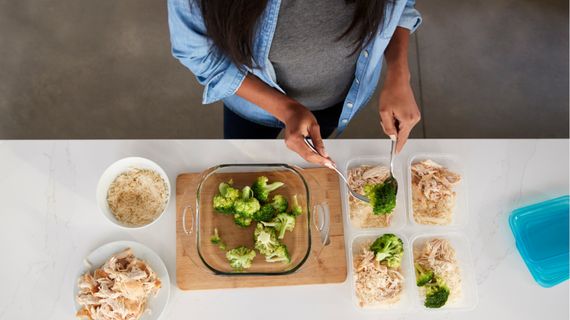
- Cook in batches for several days ahead to save time and avoid decision fatigue
- Use frozen vegetables as they’re quick, practical and cut down prep time massively
And the best part? Nutritious home‑cooked food can be ready in under an hour—without stress, without fuss and with results that truly last.
9. You don't have to cut out entire food groups (carbs or fats)
One of the most common mistakes people make when trying to “eat healthily” is attempting to eliminate carbohydrates, or alternatively, to drastically reduce fat intake. In most cases, this isn’t necessary. Both food groups have an important place in a balanced diet. What matters more than banning certain foods is choosing the right types and appropriate portions.
Carbs: not a problem, often actually helpful
Carbohydrate‑rich foods aren’t just “empty energy”. Many are excellent sources of vitamins, minerals, and fibre, especially when you choose higher‑quality, less processed options.
Here are some great examples worth including regularly in your diet:
- Wholegrain rice
- Wholegrain or rye bread
- Potatoes and sweet potatoes
- Legumes (lentils, beans, chickpeas)
- Wholegrain pasta
- Legume‑based pasta
- Legume couscous
- Oats
Fats are also important
Fats are essential for the body and definitely belong in a healthy diet. Ideally, most of your fats should come from plant sources, particularly extra virgin olive oil, which also offers a range of other health benefits.
Top sources of healthy fats include: extra virgin olive oil, flaxseed oil, nuts and seeds.
And yes, in smaller amounts, it’s perfectly fine to include saturated fats like butter orlard.They just shouldn’t be the main source of fat in your diet.

10. Caloric intake: you don't have to count, but it helps to understand the basics
The topic of calories can feel overwhelming. For many people, the word “calorie” brings up thoughts of constant weighing, tracking, and control. But that’s really not necessary—you can eat healthily without counting every bite.
That said, it’s worth understanding one basic principle: Body weight over time is determined by your energy balance—the relationship between how much energy you consume and how much you expend.
CDC puts it simply: you don’t need to count calories, but it can be useful to have a rough idea of how much energy your body needs each day.
“Healthy” ≠ automatically “diet”
This one’s important. Even high‑quality foods can be energy‑dense—think nuts, seeds, oils, avocado, granolas, nut butters. They’re nutritious and absolutely belong in a healthy diet, but portion size still matters.
When does it make sense to focus more (or less) on calories
- If your goal is weight loss, it makes sense to keep your energy intake in check (whether by tracking or simply by following sensible habits that don’t involve counting).
- If your goal is “just” to eat healthier, calories are often less important.
How to eat healthy on a budget
Eating well doesn’t have to cost more. Often, it just takes a little more planning and preparation than grabbing fast food or pre‑packaged meals. But if you plan ahead and cook at home using everyday ingredients, it’s often cheaper overall. Plus, you have more control over both quality and portion size.
How to eat healthy if you're a picky eater
If you're a picky eater, start with small steps: add one new food or a mini‑portion to meals you already like, and flavour it “your way” (sauce, spices, cheese). Play with preparation (baking/roasting often tastes better than boiling), base your diet on “safe bets” like eggs, dairy products, lean meats, and your favourite sides, and try new things without pressure—a few bites are enough; you don't have to finish everything. Be patient: sometimes it takes 10 or more tries to get used to a new taste/texture.

How to use these tips?
Don’t try to implement everything at once.
Start with just 1–2 tips today, not all ten. Ideally, choose one tip that adds something (e.g. fibre, vegetables, protein), and one that reduces something (e.g. sugary drinks)
Give yourself 7–14 days, then introduce another small change.
The goal isn't to be 100% right away; it's to improve your diet so it's a bit better than before.
Bottom line
Healthy eating isn’t about perfection or cutting out entire food groups. It’s about making a few sustainable, meaningful changes like adding more fibre, fruit/vegetables, and protein, fewer sugary drinks and ultra‑processed foods. The best approach is to start with what brings the biggest impact (enough fruit and vegetables, enough fibre and limiting sweet drinks), rely on the “healthy plate” and cook at home as often as possible. Pick 1–2 changes, stick to them for 1–2 weeks, praise yourself for progress and only then add more.